

Contents
Natural Rubber Latex 60% DRC is a raw material suitable for selected water-based adhesive formulations, including pressure-sensitive adhesives, certain shoe glues, and lamination adhesives. Both High Ammonia (HA) and Medium Ammonia (MA) latex can be evaluated, depending on preservation requirements and formulation compatibility.
The best latex for adhesive manufacturing depends on the application, processing conditions, and required bonding performance. Manufacturers should review technical specifications and conduct formulation trials before choosing a grade.
What Is Natural Rubber Latex Used for in Adhesives?


Natural rubber latex for adhesives is used in selected water-based glue formulations where flexibility, film formation, and adhesion are important. It provides a rubber component that can form flexible films, while tackifiers and other ingredients help achieve the required bonding properties.
Typical applications include:
| Application | Typical Use |
Key Consideration
|
| Adhesive / Glue | Water-based pressure-sensitive adhesives, including selected tape formulations |
Tack, peel adhesion, and shear resistance
|
| Shoes Glue | Bonding shoe linings, reinforcement fabrics, and selected upper materials |
Substrate compatibility and bond strength
|
| Lamination | Joining compatible leather, fabric, and lining layers |
Flexibility, coating behavior, and adhesion
|
In footwear adhesive manufacturing, natural latex-based formulations may be used for bonding linings and reinforcement materials. Similarly, natural rubber latex for lamination can serve as a raw material in selected systems for joining flexible material layers.
However, not all shoe glues or lamination adhesives use natural rubber latex. Suitability depends on the substrates, formulation, and manufacturing process.
Natural Rubber Latex 60% DRC is a concentrated raw material, not a ready-to-use adhesive.
For an overview of industrial uses, read Applications of Natural Rubber Latex 60% DRC.
HA vs MA Latex: Which Is Better for Adhesives?
Neither HA nor MA Latex is automatically better for adhesive manufacturing. Their main differences concern ammonia content and preservation systems, while final adhesive performance depends on the complete formulation.
| Factor | HA Latex | MA Latex |
| Ammonia content | Higher | Medium |
| Preservation | Higher ammonia-based preservation |
Lower ammonia level; complete preservative system should be checked
|
| Processing considerations | Ammonia level may influence pH and additive compatibility |
May suit processes requiring less ammonia, subject to compatibility
|
| Adhesive suitability | Requires formulation trials |
Requires formulation trials
|
Consider HA Latex when the approved raw-material specification requires a higher ammonia preservation level.
Evaluate MA Latex when a lower ammonia level is preferred and its preservation system is compatible with the adhesive formulation.
For either grade, manufacturers should verify storage stability, mixing behavior, and bonding performance through trials.
Higher ammonia content does not necessarily produce stronger adhesive bonds. The storage stability of raw latex should also not be confused with the shelf life of finished adhesive.
Other grades, including Low Ammonia (LA) Latex, may also be considered depending on the formulation.
Explore Natural Rubber Latex 60% DRC – HA, MA & LA for available grades and specifications.
What Latex Specifications Matter for Adhesive Manufacturing?
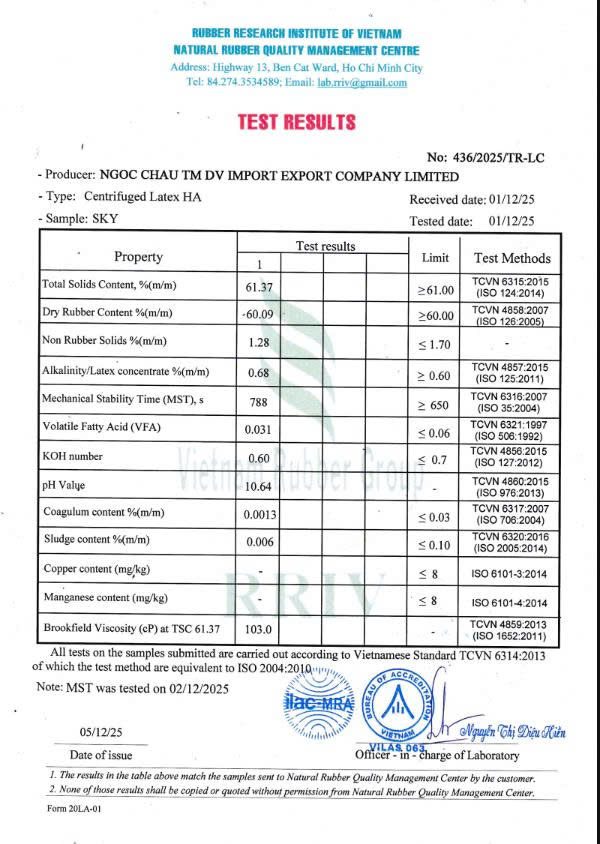
Adhesive manufacturers should check DRC, TSC, MST, VFA, and ammonia content when evaluating Natural Rubber Latex 60% DRC. These specifications help assess rubber concentration, raw-material stability, and preservation quality.
| Specification | What It Indicates | Why It Matters |
| DRC – Dry Rubber Content | Percentage of dry rubber |
Helps calculate rubber input for adhesive formulations
|
| TSC – Total Solids Content | Total rubber and non-rubber solids |
Supports solids-content and formulation control
|
| MST – Mechanical Stability Time | Resistance to mechanical destabilization under test conditions |
Helps evaluate processing stability
|
| VFA – Volatile Fatty Acid | Indicator associated with microbial activity and latex condition |
Helps assess preservation quality
|
| Ammonia Content | Ammonia concentration |
Influences preservation, pH, and formulation compatibility
|
Manufacturers may also review coagulum and sludge content, particularly when their process requires clean, consistent latex for mixing, filtration, or coating.
These parameters describe raw-material quality, but they do not independently determine finished adhesive strength.
Buyers should compare the supplier’s Technical Specification and Batch Certificate of Analysis (COA) with their approved production requirements.
For reference, ISO 2004:2024 covers specifications for ammonia-preserved natural rubber latex concentrates.
How to Choose the Best Latex for Adhesive Manufacturing?
The best latex for adhesive production should be selected according to the intended application, approved formulation, technical requirements, and trial results—not ammonia content alone.
Follow these five steps:
- Identify the application. Determine whether the latex is intended for general glue manufacturing, footwear adhesives, pressure-sensitive adhesives, or lamination.
- Choose a suitable grade. Compare HA, MA, or other grades against preservation requirements and formulation compatibility.
- Review technical documents. Request specifications and a recent Batch COA to assess DRC, TSC, MST, VFA, and ammonia content.
- Conduct formulation trials. Check mixing stability, coating performance, and suitable bonding tests, such as tack, peel adhesion, or shear resistance.
- Evaluate the supplier. Confirm batch consistency, packaging options, delivery arrangements, and material-handling requirements.
For adhesive manufacturers purchasing latex in bulk, packaging should match the factory’s unloading and storage capabilities.
See Natural Rubber Latex Packing: Flexibag vs Drum vs IBC vs Jerry Can for available shipment options.
Frequently Asked Questions
Can natural rubber latex replace synthetic latex in adhesives?
Sometimes, but not in every formulation. Natural and synthetic latex systems differ in ageing resistance, chemical resistance, adhesion, and processing behavior. Any substitution requires compatibility testing and potentially reformulation.
Is Natural Rubber Latex 60% DRC ready to use as an adhesive?
No. It is a concentrated rubber raw material. Most commercial adhesive applications require appropriate formulation, processing, and performance testing before the material can be used as a finished adhesive.
What should buyers request from a natural rubber latex supplier?
Buyers should request technical specifications, a recent Batch COA, preservation details, packaging information, and sample availability. These help verify material suitability before placing a commercial order.
Source Natural Rubber Latex 60% DRC from Vietnam
Looking for a natural rubber latex supplier in Vietnam? Ngoc Chau Natural Rubber supplies HA, MA, and LA Latex 60% DRC with flexibag, drum, IBC, and jerry can packing options.
Share your adhesive application, preferred grade, required quantity, and destination to request technical specifications, available COA documentation, and sample information.
Email: info@ngocchausupplier.com
Website: https://ngocchausupplier.com/


 Ms Evan