

Contents
- 1 What Type of Latex Is Used for Mattresses?
- 2 How Is Natural Rubber Latex Used in Mattress Manufacturing?
- 3 Why Use Natural Rubber Latex 60% DRC for Mattress Production?
- 4 Key Latex Specifications for Mattress Manufacturers
- 5 How to Choose the Right Latex Supplier for Mattress Production
- 6 Frequently Asked Questions
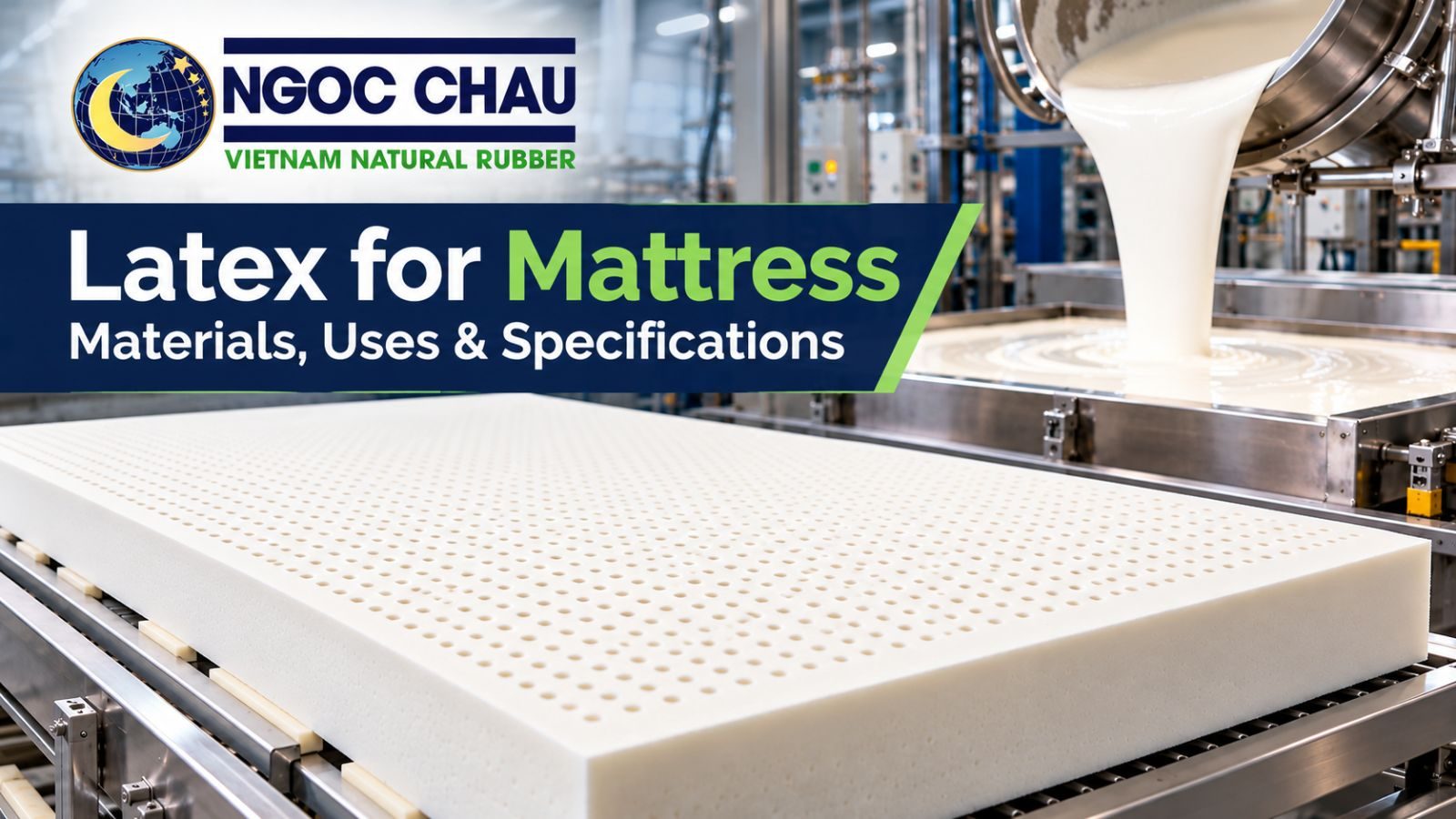
Latex for mattress manufacturing can be natural rubber latex, synthetic latex, or a blend of both. Natural rubber latex comes from the rubber tree (Hevea brasiliensis) and is commonly processed into concentrated latex with approximately 60% Dry Rubber Content (DRC). This liquid raw material is used to manufacture latex foam mattresses, latex pillows, and rubberized coir mattresses, depending on the formulation and production process.
What Type of Latex Is Used for Mattresses?
Mattress manufacturers use three main types of latex materials:
| Latex Type | Raw Material |
Typical Application
|
| Natural Rubber Latex | Latex harvested from rubber trees |
Natural latex foam mattresses and pillows
|
| Synthetic Latex | Synthetic polymers, commonly Styrene-Butadiene Rubber (SBR) |
Synthetic latex foam
|
| Blended Latex | A mixture of natural and synthetic latex |
Latex foam with selected material properties
|
Natural rubber latex contains polyisoprene polymers that provide elasticity and resilience after vulcanization.
Synthetic and blended latex are alternatives used according to the manufacturer’s product requirements, formulation, and production costs.
For natural latex mattress production, Natural Rubber Latex 60% DRC is a commonly used industrial raw material. Unlike finished latex foam, it is supplied as a milky-white liquid that requires further processing.
How Is Natural Rubber Latex Used in Mattress Manufacturing?
Natural rubber latex serves different functions depending on the mattress or bedding product.
Latex Mattress and Latex Foam
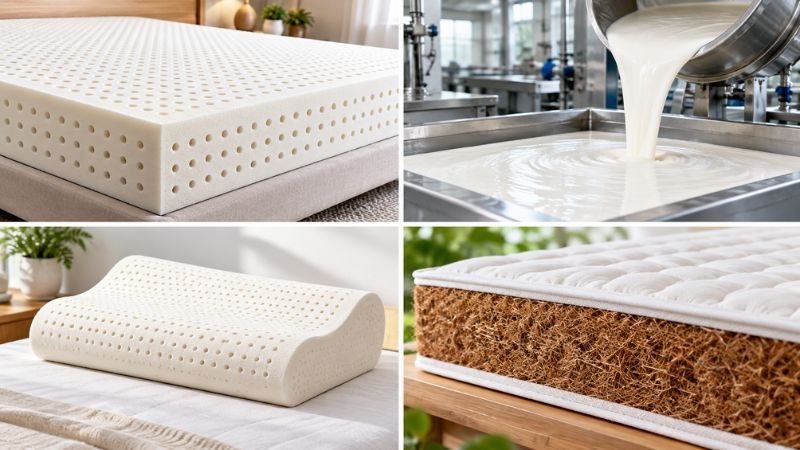
In latex foam mattress manufacturing, liquid latex is compounded with suitable foaming agents and vulcanization ingredients. The mixture is whipped into foam, molded, gelled, and vulcanized to form an elastic structure.
Two common production methods are:
- Dunlop: Foamed latex is poured into molds, gelled, and vulcanized.
- Talalay: Uses vacuum expansion and freezing stages before vulcanization.
Foam stability, shrinkage, and cell structure depend on latex quality, formulation, and processing conditions. Consistent raw materials help manufacturers maintain controlled production.
Latex Pillow
Natural rubber latex is also used to manufacture molded latex foam pillows.
The production principle is similar to latex mattress foam, while mold design, firmness, and foam properties are adjusted for pillow applications.
Coir Mattress (Rubberized Coir)
For rubberized coir mattresses, compounded natural rubber latex is sprayed onto coconut coir fibers.
After appropriate drying, pressing, and curing, the rubber binds the fibers together, creating a resilient mattress core.
Unlike latex foam mattresses, rubberized coir mattresses rely primarily on coconut fibers for their structural support, with latex acting as a flexible binder.
Why Use Natural Rubber Latex 60% DRC for Mattress Production?
Natural Rubber Latex 60% DRC is produced by concentrating field latex, commonly through centrifugation, to increase the dry rubber content to approximately 60%.
For mattress manufacturers, concentrated latex offers several practical benefits:
- Rubber concentration: Reduces water transportation compared with field latex.
- Formulation control: Helps calculate the required dry rubber quantity.
- Processing versatility: Can be evaluated for latex foam, pillows, and rubberized coir.
- Bulk supply: Supports industrial storage and transportation under suitable conditions.
However, 60% DRC alone does not guarantee successful foam production. Latex stability, preservation, compounding, and curing conditions must also be evaluated.
Explore our Natural Rubber Latex 60% DRC specifications for available grades and supply information.
Key Latex Specifications for Mattress Manufacturers
Before purchasing natural rubber latex, manufacturers should review the supplier’s Technical Data Sheet (TDS) and batch Certificate of Analysis (COA).
| Parameter | Why It Matters |
| DRC – Dry Rubber Content |
Determines dry rubber concentration for formulation calculations
|
| TSC – Total Solids Content |
Indicates total rubber and non-rubber solids
|
| MST – Mechanical Stability Time |
Measures stability under mechanical agitation
|
| VFA – Volatile Fatty Acid Number |
Helps assess latex preservation and microbial deterioration
|
| Ammonia Content |
Influences preservation, storage, and processing compatibility
|
| Coagulum Content |
Indicates coagulated rubber particles that may affect processing
|
Ngoc Chau’s published reference specifications include DRC ≥60%, MST ≥650 seconds, and VFA ≤0.06. Buyers should confirm the applicable requirements against the agreed specification and actual batch COA.
HA vs LA Latex for Mattress Production
Natural rubber latex is available in different ammonia preservation grades:
- HA Latex (High Ammonia): Higher ammonia content supports preservation during storage and transportation.
- LA Latex (Low Ammonia): Lower ammonia content may be preferred for processes requiring reduced ammonia levels.
- MA Latex (Medium Ammonia): An intermediate option, subject to formulation compatibility.
LA latex can be considered for mattress foam production where ammonia odor and processing requirements are important. However, LA is not automatically better than HA for every foam formulation.
Manufacturers should evaluate preservation requirements, production conditions, and sample performance before selecting a grade.
How to Choose the Right Latex Supplier for Mattress Production
A suitable natural rubber latex supplier should provide consistent material quality and documentation for industrial purchasing.
Before ordering, manufacturers should check:
- Batch consistency: Stable DRC, MST, VFA, and other agreed specifications.
- Quality documentation: Technical specifications, batch COA, and Safety Data Sheet (SDS).
- Sample testing: Compatibility with the factory’s foam or rubberized coir formulation.
- Preservation system: Suitable HA, MA, or LA latex grade.
- Export capability: Appropriate packaging, storage, and shipment arrangements.
Common packaging options include Flexibag, IBC Tank, Steel Drum, and Jerry Can.
Production trials are recommended before large-volume purchasing, particularly when changing latex suppliers or preservation grades.
For more information, see our Natural Rubber Latex Packing Guide.
Frequently Asked Questions
Can Natural Rubber Latex 60% DRC be used for mattresses and pillows?
Yes. It is commonly used for natural latex foam mattresses and molded pillows, subject to formulation compatibility.
Is the same latex suitable for latex foam and rubberized coir?
Potentially. Both can use concentrated natural rubber latex, but their compounding, processing, and performance requirements differ.
Looking for Natural Rubber Latex 60% DRC for mattress manufacturing?
Contact Ngoc Chau Natural Rubber to request technical specifications, discuss HA/MA/LA grades, evaluate samples, or obtain a quotation for your production needs.
Hotline / Mobile: +84 762 798 888
Email: info@ngocchausupplier.com


 Ms Evan