

Contents
- 1 Natural Rubber Latex Packing: Quick Comparison
- 2 Which Natural Rubber Latex Packing Should You Choose?
- 3 Flexibag: Best for Bulk Latex Consumption
- 4 Steel Drum: Best for Batch-by-Batch Handling
- 5 IBC Tank: Best for Tank-by-Tank Handling
- 6 Jerry Can: Best for Small-Unit Distribution
- 7 Can Your Shipping Route Change the Packing Choice?
- 8 A Simple Way to Decide
- 9 What Should You Send Your Supplier Before Requesting a Quote?
- 10 Frequently Asked Questions
- 11 Choose Packing Based on What Happens After Arrival
For natural rubber latex packing, the right choice depends mainly on what happens after the container arrives:
- Bulk consumption + direct unloading → Flexibag
- Batch-by-batch handling → Steel Drum
- Tank-by-tank handling → IBC Tank
- Small-unit redistribution → Jerry Can
The packing that loads the most Latex is not automatically the best option. Your factory’s unloading system, production method, storage arrangement and inland transportation should also fit the packing.
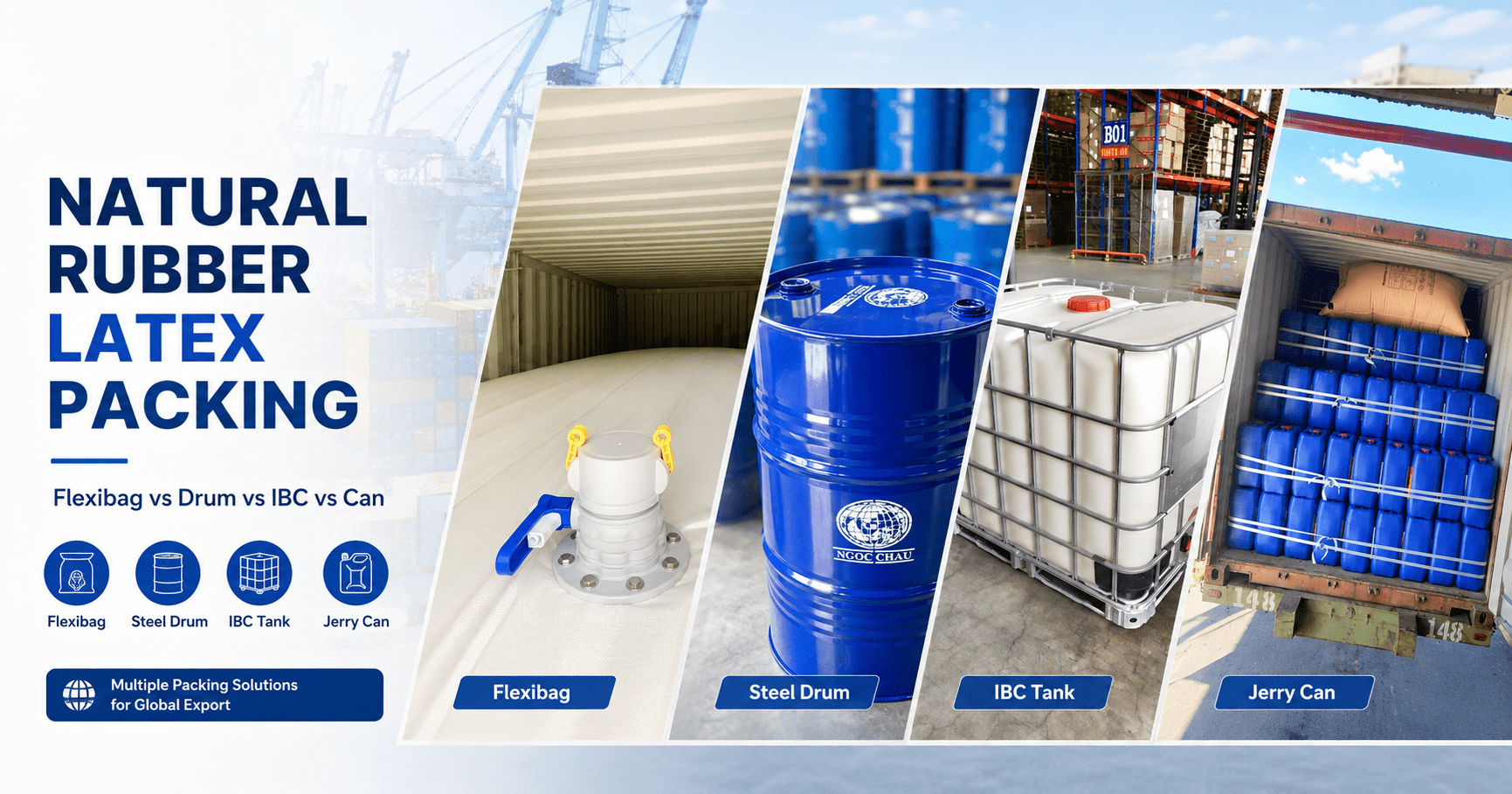
Natural Rubber Latex Packing: Quick Comparison
| Packing | Typical Loading | Best For | Handling Model | Main Consideration |
|---|---|---|---|---|
| Flexibag | 20 / 21 / 21.5 MT per 20DC | Bulk-consuming factories | Full bulk unloading | Requires suitable unloading setup |
| Steel Drum | 16–16.4 or 19.6–20.09 MT per 20DC | Factories using Latex in batches | Drum by drum | More flexible handling and storage |
| IBC Tank | 19.2 MT per 20DC | Factories without dedicated bulk storage | Tank by tank | Balance between bulk and individual handling |
| Jerry Can | 22.5 MT per 20DC | Traders and smaller-unit distribution | 25 kg units | Distribution flexibility |
Which Natural Rubber Latex Packing Should You Choose?
Start with your receiving and production setup.
If your factory consumes Latex in bulk and can unload a full container efficiently, Flexibag should usually be evaluated first.
If production uses Latex gradually by batch and needs individual units that are easier to move around the factory, Steel Drum may be more practical.
If you want to handle approximately one tonne at a time without installing a dedicated bulk Latex storage system, IBC Tank provides a useful middle option.
If the Latex will be divided and supplied to several factories or smaller users, Jerry Can offers the greatest redistribution flexibility.
This is why packing should be selected around the operation, not simply around packaging price or maximum container payload.
Flexibag: Best for Bulk Latex Consumption
Flexibag is generally the most practical option for factories that consume Natural Rubber Latex in relatively large volumes and have a suitable bulk unloading system.
For Ngoc Chau Natural Rubber shipments, the reference Flexibag loading options are:
- 20 MT / 20DC
- 21 MT / 20DC — preferred
- 21.5 MT / 20DC
Our preferred regular loading is approximately 21 MT per 20DC.
Although 21.5 MT increases the amount of Latex in one container, maximizing payload is not always the best transportation decision. At the higher loading level, the risk of container side-wall bulging may increase, so actual route and container conditions should also be considered.
Flexibag is worth evaluating when:
- Your factory consumes Latex in bulk
- You have a suitable unloading system
- Latex can be transferred efficiently into storage or production
- You want to reduce individual packaging
A useful question to ask before choosing Flexibag is:
Can our factory efficiently receive and unload one full bulk Latex shipment?
If the answer is yes, Flexibag is often the first packing option to compare.


Does Latex Flexibag require a reefer container?
In the typical Ngoc Chau Natural Rubber Flexibag setup, Latex is shipped in a standard dry container, rather than automatically using a reefer container.
Additional insulation may be considered depending on shipment conditions.
The important point is that container preparation should be confirmed before loading rather than assuming that every Latex shipment requires the same arrangement.
Steel Drum: Best for Batch-by-Batch Handling
Steel Drum is more suitable when flexibility inside the factory is more important than receiving one full bulk load.
Two reference loading configurations are commonly used by Ngoc Chau:
Option 1
- 80 drums
- 200–205 kg Latex per drum
- Approximately 16–16.4 MT / 20DC


Option 2
- 98 drums
- 200–205 kg Latex per drum
- Approximately 19.6–20.09 MT / 20DC
The 98-drum option improves container utilization, but it also leaves less free space for drum protection and securing.
Steel Drum can be practical for:
- Factories consuming Latex batch by batch
- Production lines without fully automated Latex feeding
- Buyers that need flexible internal movement
- Traders redistributing Latex in larger individual units
- Operations where one full bulk unloading is inconvenient
Compared with Flexibag, Drum requires more individual packaging and handling.
Its advantage is operational flexibility.
If your factory wants to move Latex to production only when each batch is required, Steel Drum may fit the operation better than Flexibag.
IBC Tank: Best for Tank-by-Tank Handling
IBC Tank provides a useful balance between bulk delivery and smaller individual packing.
In Ngoc Chau’s reference configuration:
- 960 kg Latex / IBC Tank
- 20 IBC Tanks / 20DC
- Total: 19.2 MT / 20DC


For larger containers:
- 26 IBC Tanks / 40DC / 40HC / 40RH
- Total: 24.96 MT
IBC can be particularly useful when:
- The factory does not have dedicated bulk Latex storage
- Full Flexibag unloading is inconvenient
- Production prefers tank-by-tank handling
- The shipping route makes Flexibag less practical
- A trader delivers Latex directly to factories
The main advantage is that the buyer can receive and use the material one tank at a time.
That makes IBC a good option for factories that need more handling flexibility than Flexibag but do not want to move down to dozens of individual drums.
What about 40RH?
For Ngoc Chau shipments where a 40RH is specifically selected, the reference setup is:
- Temperature: 15–20°C
- Ventilation: fully closed
- Loading: 26 IBC Tanks
- Latex quantity: 24.96 MT
This does not mean every IBC shipment requires a refrigerated container.
Container type should be selected according to the shipment requirement.
Jerry Can: Best for Small-Unit Distribution
Jerry Can serves a different purpose from the other three packing options.
Ngoc Chau’s reference configuration is:
- 25 kg Latex / Jerry Can
- 900 cans / 20DC
- Total: 22.5 MT / 20DC


The main advantage is not lower packaging cost.
It is distribution flexibility.
Jerry Can can be suitable for:
- Retail or wholesale traders
- Buyers supplying several factories
- Distributors selling Latex in smaller quantities
- Businesses that need easily movable units
For example, a trader receiving one container may need to divide the Latex among many customers rather than send the complete container to one factory.
In this situation, 25 kg units can be much easier to redistribute than Flexibag, IBC or Steel Drum.
So the key question is:
Will the Latex be consumed by one factory, or redistributed to multiple smaller users?
If redistribution is the main requirement, Jerry Can deserves consideration.
Can Your Shipping Route Change the Packing Choice?
Yes.
Knowing only the destination port is sometimes not enough.
A shipment may continue:
Sea → Port → Truck → Factory
or:
Sea → Port → Railway → Inland destination → Factory
Before confirming packing, it is useful to check:
- Destination port
- Final inland destination
- Truck or railway transportation
- Container requirements
- Temperature-control requirements, if any
- Factory unloading system
For example, if a Flexibag container will continue inland by railway, this should be communicated before loading so the shipment arrangement can be reviewed accordingly.
This is one reason why two buyers purchasing the same Latex grade may still use different packing.
Their product may be the same, but their logistics and factory operations are different.
A Simple Way to Decide
Ask these four questions:
1. Can we unload and consume Latex in bulk?
→ Evaluate Flexibag
2. Do we need drum-by-drum or batch-by-batch handling?
→ Evaluate Steel Drum
3. Do we prefer handling approximately one tank at a time?
→ Evaluate IBC Tank
4. Do we need to redistribute Latex in small units?
→ Evaluate Jerry Can
This is a practical screening method rather than an absolute rule.
The final packing should still be checked against the shipment route and receiving conditions.
What Should You Send Your Supplier Before Requesting a Quote?
Instead of sending only:
“Please quote Natural Rubber Latex CIF.”
provide a few operational details:
- Required Latex grade
- Quantity per shipment
- Monthly consumption
- Destination port
- Final inland destination
- Truck or railway transportation after the port
- Factory unloading system
- Bulk storage availability
- Temperature-control requirements, if any
- Distribution model
These details help the supplier compare packing options based on your actual operation rather than simply quoting the highest possible loading.
For product specifications and available grades, see our Natural Rubber Latex 60% DRC.
Frequently Asked Questions
What is the best packing for Natural Rubber Latex?
There is no single best option. Flexibag generally fits bulk consumption, Steel Drum fits batch-by-batch handling, IBC fits tank-by-tank handling, and Jerry Can fits smaller-unit redistribution.
How much Natural Rubber Latex can a 20DC carry?
It depends on the packing. Ngoc Chau’s reference configurations include 20–21.5 MT in Flexibag, approximately 16–20.09 MT in Steel Drums, 19.2 MT in IBC Tanks, and 22.5 MT in Jerry Cans.
Flexibag or Steel Drum: which is better for a factory?
Evaluate Flexibag if your factory can efficiently unload and consume Latex in bulk. Steel Drum may be more practical when production requires drum-by-drum or batch-by-batch handling.
Does Natural Rubber Latex in Flexibag require a reefer container?
Not in Ngoc Chau Natural Rubber’s typical Flexibag arrangement. A standard dry container is normally used, while additional insulation may be considered depending on shipment conditions.
Choose Packing Based on What Happens After Arrival
The practical way to choose Natural Rubber Latex packing is not to ask only:
“Which packing loads more?”
Ask instead:
“Which packing fits what we will do with the Latex after the container arrives?”
Bulk consumption → Flexibag
Batch-by-batch handling → Steel Drum
Tank-by-tank handling → IBC Tank
Small-unit redistribution → Jerry Can
At Ngoc Chau Natural Rubber, packing discussions normally start with the buyer’s operation: monthly consumption, destination, inland transportation, unloading setup and distribution model.
If you are comparing packing options for an upcoming Latex shipment, send us these details. We can review which option is more practical before quotation.


 Ms Evan