

Contents
Executive Summary
As of May 4, 2026, the Vietnam rubber price today reflects a market in consolidation:
- Futures remain elevated relative to historical averages
- Physical demand recovery is incomplete
- Price action is range-bound with an upward bias
The market is currently driven more by macro conditions than by synchronized demand recovery.

Global Futures Market Overview
TOCOM (Osaka Exchange – Japan)
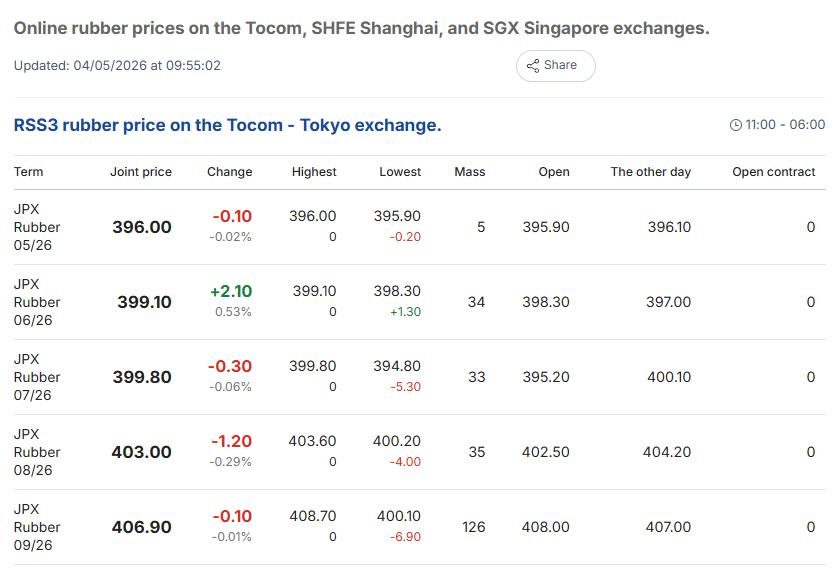
Rubber futures continue to trade within a high range:
- May 2026: ~396 JPY/kg
- June 2026: ~399 JPY/kg
- August 2026: ~403 JPY/kg
- September 2026: ~406.9 JPY/kg
Recent performance:
- Peak: ~410.5 JPY/kg
- Intraday high: ~414 JPY/kg
- Monthly increase: ~7.9%
Quantitative context:
- Current levels remain approximately 10–12% above the 6-month average range
- Volatility has increased, but price floor remains relatively firm
Assessment:
- The market is not in a reversal phase
- Downward moves are largely technical corrections within an elevated range
SHFE (Shanghai Futures Exchange – China)
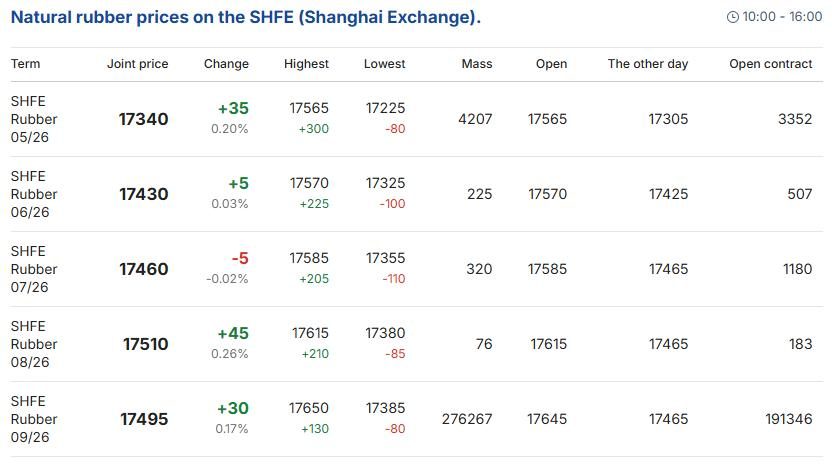
- May 2026: ~17,340 CNY/ton
- June 2026: ~17,430 CNY/ton
- August 2026: ~17,510 CNY/ton
Observed dynamics:
- Limited upward momentum
- Elevated inventories
- Conservative restocking behavior
Assessment:
- Demand is stable but lacks acceleration
- Insufficient to drive a sustained bullish breakout
Vietnam Rubber Price Today – Domestic Market Conditions
The Vietnam rubber price today remains stable across major producers:
- Ba Ria: ~420 VND/TSC
- Phu Rieng: ~420 VND/TSC
- Binh Long: 422–432 VND/TSC
- Mang Yang: 458–463 VND/TSC
Assessment:
- Domestic pricing remains anchored
- Reflects balanced local supply-demand conditions
- Stability is indirectly supported by global futures strength
From a supply chain perspective, transaction feedback from exporters such as Ngoc Chau Natural Rubber indicates:
Limited short-term price renegotiation pressure in export contracts
This suggests that:
- Buyers are not aggressively delaying purchases
- Current price levels are being accepted in phased procurement strategies
Key Market Drivers
1. Currency Factor (JPY Weakness)
- JPY ~160.58/USD
Impact:
- Enhances attractiveness of yen-denominated commodities
- Supports speculative and financial inflows into futures
2. Energy Market Spillover
- Brent crude oil: +~7%
Impact:
- Increases synthetic rubber production costs
- Strengthens relative competitiveness of natural rubber
3. Supply Expectations
- Anticipated increase in supply from selected regions
Impact:
- Caps aggressive upward momentum
- Introduces downward pressure on sentiment
4. Demand Conditions
- China: cautious restocking
- India: extended weak demand cycle
Impact:
- Demand recovery remains fragmented and uneven
- Limits price acceleration
Market Interpretation
The current divergence between futures and physical markets indicates:
Price strength is primarily macro-driven rather than demand-driven
Key observations:
- Futures markets reflect financial positioning and currency dynamics
- Physical markets reflect inventory management and consumption constraints
Export-side observations (including from suppliers such as Ngoc Chau Natural Rubber) reinforce that:
- Buyers are shifting toward incremental purchasing
- Large-volume commitments are being deferred or split into phases
Scenario Outlook
Bullish Scenario
- Continued oil price increase
- Recovery in Chinese industrial demand
→ Potential breakout above recent highs
Base Case (Most Likely)
- Stable macro conditions
- Gradual demand recovery
→ Range-bound movement with upward bias
Bearish Scenario
- Faster-than-expected supply increase
- Further slowdown in China
→ Downward correction, but likely limited in depth
Price Outlook
Short-Term
- Volatility remains elevated
- Price movement influenced by:
- Oil price direction
- Currency trends
- China procurement signals
Medium to Long-Term
- Reference level: ~110.39 US cents/pound (FRED)
- Technical indicators: positive momentum persists
The market is expected to remain structurally supported, though lacking strong acceleration catalysts.
Conclusion
As of May 4, 2026, the Vietnam rubber price today reflects:
- A market supported by macro tailwinds
- Constrained by incomplete demand recovery
The result is:
A stable yet volatile market environment, characterized by consolidation rather than directional breakout


 Ms Evan