

Contents
- 1 Why is natural rubber latex used in adhesives?
- 2 Latex HA or MA: which one to choose for glue?
- 3 What characteristics of latex are important for adhesive production?
- 4 Как выбрать натуральный латекс для производства клея?
- 5 Что запросить у поставщика перед испытанием?
- 6 Часто задаваемые вопросы
- 7 Natural latex 60% DRC from Vietnam
Natural latex 60% DRC is a concentrated raw material for certain water-based adhesives, including self-adhesive materials, some types of shoe glue, and laminating adhesives. Depending on raw material preservation requirements and formulation compatibility, High Ammonia (HA) and Medium Ammonia (MA) latex grades are available.
The choice of natural latex for adhesive production depends on the application, processing conditions, and the desired adhesive properties. Before selecting a grade, the manufacturer should compare the raw material specifications with production requirements and conduct formulation testing.
Why is natural rubber latex used in adhesives?


Natural rubber latex for adhesives is used in certain water-based formulations where elasticity, film formation, and adhesion are important. Latex serves as the rubber component capable of forming an elastic film; tackifiers and other ingredients help achieve the desired bonding properties.
Typical areas of application include:
| Scope of application | Typical application |
What to consider
|
| Glue | Water-based self-adhesive compositions, including individual adhesive formulations for tapes |
Tack, peel adhesion and shear strength
|
| Shoe glue | Bonding of linings, reinforcing materials and individual upper materials |
Material compatibility and bond strength
|
| Lamination | Joining compatible layers of leather, fabric and lining |
Elasticity, coating properties and adhesion
|
In the production of shoe adhesives, natural latex-based compounds can be used to bond linings and reinforcing materials. Natural rubber latex can also be used as a raw material for certain adhesive systems for laminating flexible materials.
However, not all shoe adhesives and laminating compounds use natural latex. Suitability depends on the materials being bonded, the formulation, and the manufacturing process.
Natural latex 60% DRC is a raw material, not a ready-to-use adhesive. Its suitability for a specific adhesive formulation must be confirmed through compatibility testing and formulation testing.
An overview of industrial applications is given in the article Applications of Natural Latex 60% DRC .
Latex HA or MA: which one to choose for glue?

It’s not always the case that HA or MA latex is better for adhesive production. The main differences are related to the ammonia content and preservation system, while the final adhesive properties depend on the entire formulation and production conditions.
| Parameter | Latex HA | Latex MA |
| Ammonia content | Higher | Average |
| Conservation | Canned food with higher ammonia content |
Lower ammonia levels; the entire preservative system should be checked
|
| Processing Features | Ammonia content can affect pH and additive compatibility. |
May be suitable for processes requiring less ammonia, subject to compatibility
|
| Suitability for adhesive | Formulation testing required |
Formulation testing required
|
Consider HA latex if the approved raw material specification requires a higher level of ammonia preservation.
Consider MA latex if lower ammonia levels are preferred and the preservation system is compatible with the adhesive formulation.
Both grades should be tested for storage stability, mixing behavior, and adhesion properties. The final choice should be based on raw material specifications, process requirements, and test results.
A higher ammonia content does not, by itself, indicate a stronger adhesive bond. The shelf life of raw latex should also not be confused with the shelf life of the finished adhesive.
Depending on the formulation, other brands may also be considered, including Low Ammonia (LA) Latex.
What characteristics of latex are important for adhesive production?
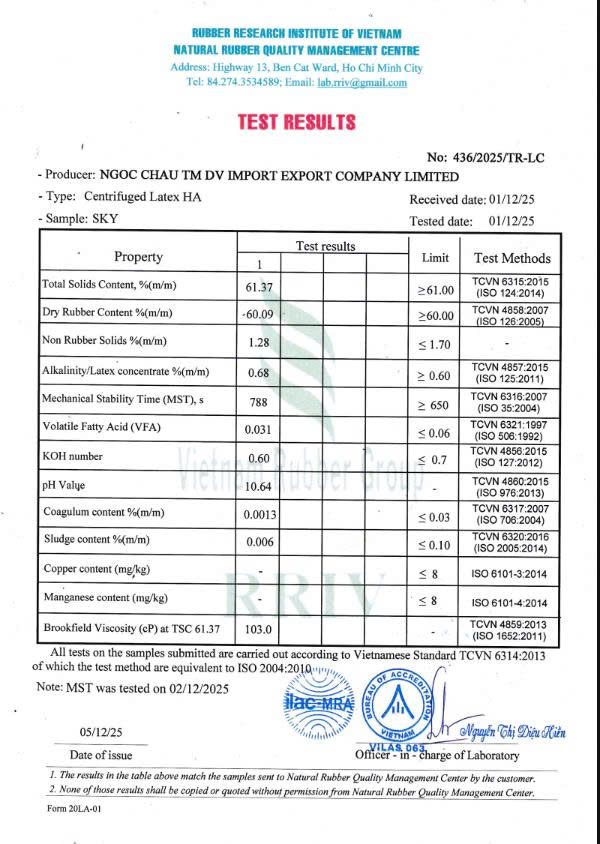
When evaluating natural rubber latex with a DRC rating of 60%, adhesive manufacturers should check the DRC, TSC, MST, VFA, and ammonia content . These parameters help assess the proportion of dry rubber, total solids content, mechanical stability, and raw material condition. The required values should be compared with the specifications agreed upon for the specific production process.
| Indicator | What does it show? | Why is this important? |
| DRC — dry rubber content | Dry rubber content |
Helps calculate the amount of rubber for an adhesive formulation
|
| TSC — total solids content | Total rubber and non-rubber solids |
Helps control dry matter content and formulation
|
| MST — mechanical stability time | Resistance to mechanical destabilization under test conditions |
Helps assess processing stability
|
| VFA — volatile fatty acids | An indicator related to microbiological activity and latex condition |
Helps to assess the condition and safety of raw materials
|
| Ammonia content | Концентрация аммиака |
Влияет на консервацию, pH и совместимость с рецептурой
|
Производители также могут проверять содержание коагулюма и шлама, особенно если для смешивания, фильтрации или нанесения покрытия требуется чистый и однородный латекс.
Эти показатели характеризуют качество сырья, но по отдельности не определяют прочность готового клеевого соединения.
Покупателям следует сопоставить техническую спецификацию поставщика и сертификат анализа конкретной партии (Batch COA) с утверждёнными требованиями производства.
Для справки: стандарт ISO 2004:2024 охватывает спецификации концентратов натурального каучукового латекса, консервированных аммиаком.
Как выбрать натуральный латекс для производства клея?
Натуральный латекс для клея следует выбирать с учётом области применения, утверждённой рецептуры, технических требований и результатов испытаний. Одного содержания аммиака недостаточно для выбора подходящего сырья.
Рекомендуется пройти пять этапов:
- Определите область применения. Уточните, предназначен ли латекс для общего производства клея, обувного клея, самоклеящихся составов или ламинирования.
- Выберите марку для оценки. Сопоставьте HA, MA или другие марки с требованиями к консервации сырья и совместимостью с рецептурой. Окончательный выбор подтвердите испытаниями.
- Запросите технические документы. Попросите спецификацию и актуальный сертификат анализа партии (Batch COA), чтобы оценить DRC, TSC, MST, VFA и содержание аммиака.
- Проведите испытания рецептуры. Проверьте стабильность при смешивании, свойства нанесения покрытия и подходящие показатели склеивания, например липкость, адгезию при отслаивании или прочность при сдвиге.
- Оцените условия поставки. Уточните стабильность характеристик партий, варианты упаковки, доставку и требования к разгрузке, хранению и обращению с материалом.
Что запросить у поставщика перед испытанием?
Чтобы оценить натуральный латекс как сырьё для adhesive, покупателю следует сообщить поставщику область применения, требования к марке и технической спецификации, а также запросить Technical Specification и Batch COA. До коммерческой закупки можно уточнить доступность образца и проверить сырьё в собственной рецептуре.
При оптовой закупке также укажите требуемый объём, предпочтительную упаковку, пункт назначения и возможности предприятия по разгрузке и хранению. Это поможет обсудить вариант поставки с учётом реального производственного процесса.
Варианты отгрузки описаны в статье Упаковка натурального латекса: флекситанк, бочки, IBC и канистры.
Часто задаваемые вопросы
Может ли натуральный каучуковый латекс заменить синтетический латекс в клеях?
Sometimes, but not in every formulation. Systems based on natural and synthetic latex differ in their resistance to aging and chemical attack, adhesion, and processing behavior. Substitution requires compatibility testing and, in some cases, a reformulation.
Can 60% DRC natural latex be used as a ready-to-use adhesive?
No. It’s a concentrated rubber raw material. Most industrial adhesives require proper formulation and processing, as well as performance testing of the finished product.
What documents and information should I request from a natural latex supplier?
Request technical specifications, the latest Batch COA, information about the preservation system and packaging options, and information about sample availability. This information will help you verify the suitability of the raw materials before placing a commercial order.
Natural latex 60% DRC from Vietnam
Looking for a natural rubber latex supplier from Vietnam ? Ngoc Chau Natural Rubber supplies 60% DRC latex in grades HA, MA, and LA, available in Flexibags, drums, IBCs, and canisters.
To request specifications, available COAs and sample information, please specify your adhesive application, preferred grade, required volume, packaging and destination.
Email: info@ngocchausupplier.com
Website: https://ngocchausupplier.com/ru/


 Ms Evan